
School technology · Insights
- digital transformation schools cameroon
- cba report cards
School digitalisation is most successful when it begins with an operating problem, not with a long list of fashionable features. A proprietor may need faster fee reporting. A principal may need reliable marks and report cards. Parents may need clearer communication. These needs should determine the order of implementation.
This roadmap is written for proprietors, principals, head teachers and administrators of nursery, primary, secondary and higher institutions in Cameroon. It explains how to move from paper and scattered spreadsheets to connected digital systems in stages that staff can actually absorb.
1. Start with the school's operating reality
Document how the school currently handles admissions, student records, fees, attendance, timetables, discipline, marks and communication. Identify duplicate work, delays, frequent errors and processes that depend on one person. This creates a practical baseline for deciding what to digitise first.
Questions to ask your team
- How long does it take to produce report cards at the end of each sequence or term?
- How many times is the same student information written down in different registers?
- How does the bursar know, today, which students still owe fees?
- How do parents learn about results, absences or school events?
- What happens if the person who manages the marks spreadsheet is absent or leaves?
The answers usually point clearly to where the pain is greatest, which is where digitalisation should begin.
2. Secure the public digital foundation
A school should control its domain name, hosting account, professional email addresses and website content. The website should explain the school clearly, show programmes and facilities, provide admissions guidance and give families an obvious way to make contact.
Parents increasingly search for schools on Google and Google Maps. A verified Google Business Profile with accurate location, photos and contact details helps families find the school and see that it is real. For Emergence Bilingual University Institute, MOGADONKO delivered the website together with the domain, hosting, professional emails and a Google Business Profile with a Google Maps listing.
3. Digitise high-friction academic work
Results processing is often a strong next step because the benefit is visible to everyone. Teachers spend fewer evenings calculating averages, administrators stop retyping marks, and parents receive clearer report cards on time.
What a Cameroon school system must support
- The school's levels, classes, subjects and coefficients.
- Sequences, terms and annual averages calculated the way the school already works.
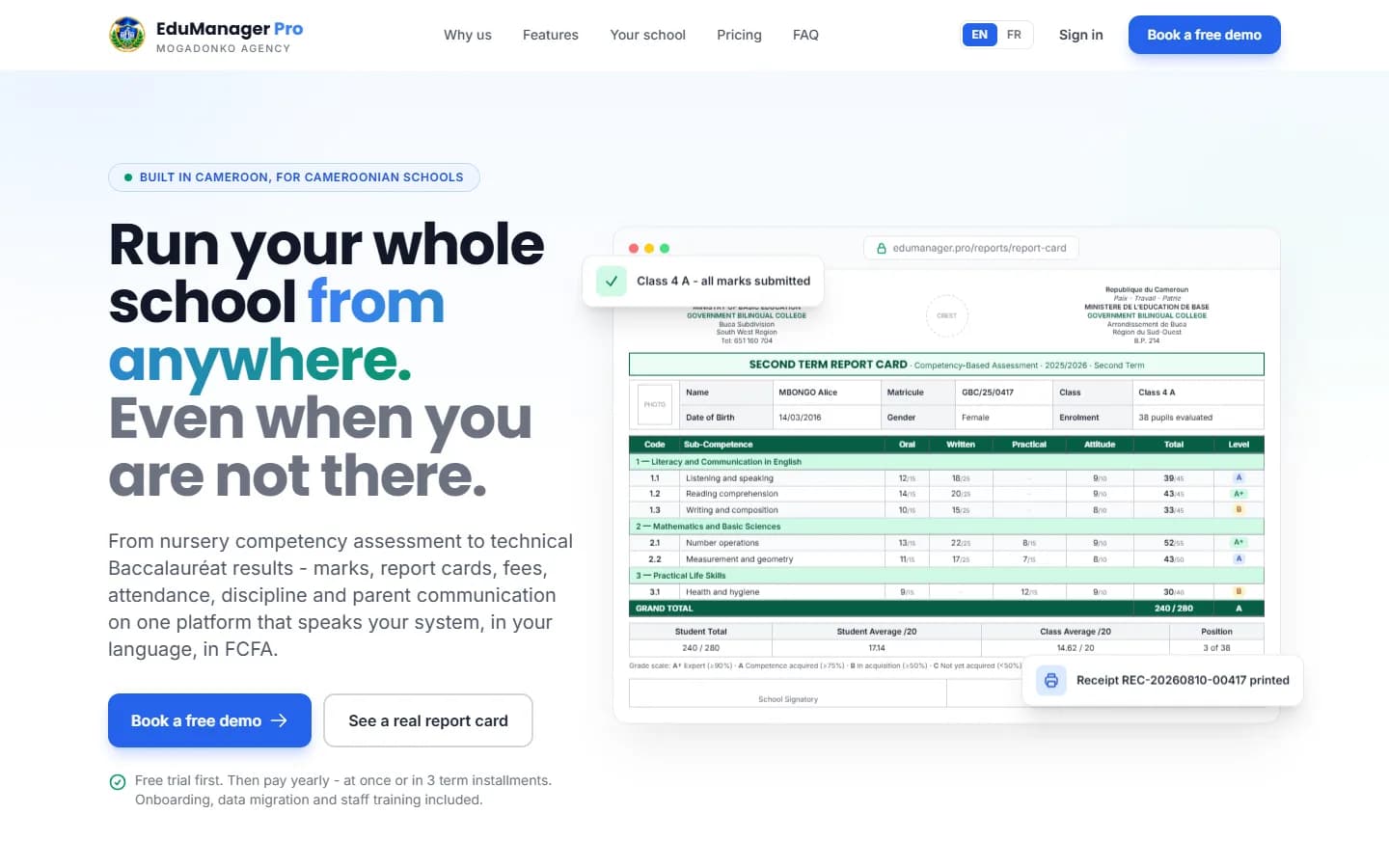
- Competency-based assessment (CBA) report cards for nursery and primary sections.
- Several report-card layouts, because different sections and institutions use different formats.
- Both English and French, for bilingual schools and for anglophone and francophone subsystems.
- An approval step, so marks are checked before results are published.
A marks tracker that shows which teachers have submitted marks and which are still pending saves administrators from chasing staff room by room.
4. Connect administration gradually
After the academic workflow is stable, the school can connect fees, attendance, discipline, admissions and parent communication. A staged rollout makes training easier and reduces the risk of trying to change every department at once.
Fees and mobile money
Many Cameroonian parents pay fees through MTN Mobile Money or Orange Money. A school system should let the bursar record these payments with their references, issue receipts, and see balances per student and per class without manual compilation. Clear receipts reduce disputes with parents.
Roles and permissions
Different staff need different access. A teacher enters marks for their own subjects; a bursar manages fees; a principal approves results; a proprietor sees summaries. Defining roles carefully protects sensitive information and makes responsibility clear.
Parent communication
A parent portal lets families see results, fee balances and announcements without queuing at the school office. It also reduces the number of phone calls staff receive at the end of each term.
Attendance and discipline
Daily attendance and discipline records become far more useful when they sit beside marks and fees. A principal can see whether a student's falling results coincide with repeated absences, and parents can be informed early rather than at the end of the term. Keep the recording process simple enough that teachers can complete it in a few minutes.
5. Train people, not just install software
Technology fails in schools most often because staff were never properly trained, or because training happened once and was forgotten. Plan short, practical sessions for each role, using the school's real classes and data. Identify a few confident staff members as internal champions who can help colleagues day to day.
- Train administrators first, so they can configure classes, subjects and users.
- Train teachers on mark entry well before the first deadline.
- Run a trial sequence or term in parallel with the old method if staff confidence is low.
- Collect feedback and adjust settings before the next term.
Timing matters. Introducing a new system in the week before examinations or report cards are due creates pressure and resistance. The beginning of a term or the holiday period gives staff time to learn without deadlines. If your school needs broader staff skills, MOGADONKO Academy also offers training, including practical sessions on using AI assistants for everyday administrative work.
6. Protect student and financial data
Moving records online brings responsibilities. Student marks, family contacts and fee balances are sensitive, and a school must be able to show that it handles them carefully.
- Give each staff member a personal account; never share one administrator password across the office.
- Remove access promptly when a staff member leaves the school.
- Make sure regular backups exist and that someone has tested restoring them.
- Keep a record of who changed marks or payments, and when.
These controls also protect staff, because a clear record shows who did what if a result or a payment is ever questioned.
7. Measure whether the change is working
- Time required to prepare report cards.
- Percentage of marks submitted before the deadline.
- Speed and accuracy of fee reconciliation.
- Parent response to school communication.
- Number of repeated manual records removed.
Record these measures before you start so the improvement can be seen clearly. A school that can show staff and parents what changed will find the next stage much easier to introduce.
How EduManager Pro supports this roadmap
EduManager Pro is MOGADONKO's bilingual school platform built for Cameroon. It provides CBA report cards, 13 user roles, 8 report-card templates, fee management with receipts for MTN Mobile Money and Orange Money payments, a parent portal and a marks tracker. Schools can begin with a focused demonstration and agree on a staged deployment based on their actual priorities.
Frequently asked questions
What is the best school management software in Cameroon?
The best system is one that matches your levels, subjects, coefficients, report-card formats and languages, supports CBA where needed, and comes with local training and support. EduManager Pro is built specifically for Cameroonian schools.
Can school software produce CBA report cards?
Yes, if it is designed for it. EduManager Pro supports competency-based assessment report cards for nursery and primary sections alongside traditional report cards.
Can parents pay school fees by mobile money?
Many schools accept MTN Mobile Money and Orange Money. A school platform should record these payments with their references and issue clear receipts so balances stay accurate.
Where should a school start its digital transformation?
Start with the process that causes the most delay or errors, often report cards or fee tracking, and secure the school's domain, website and professional email in parallel.
Does a school need a website if it has a Facebook page?
Yes. A website on the school's own domain is owned and controlled by the school, appears in Google searches and supports professional email. Social media works best alongside it, not instead of it.